AI can discover drugs. Multiply Labs wants robots to manufacture them.
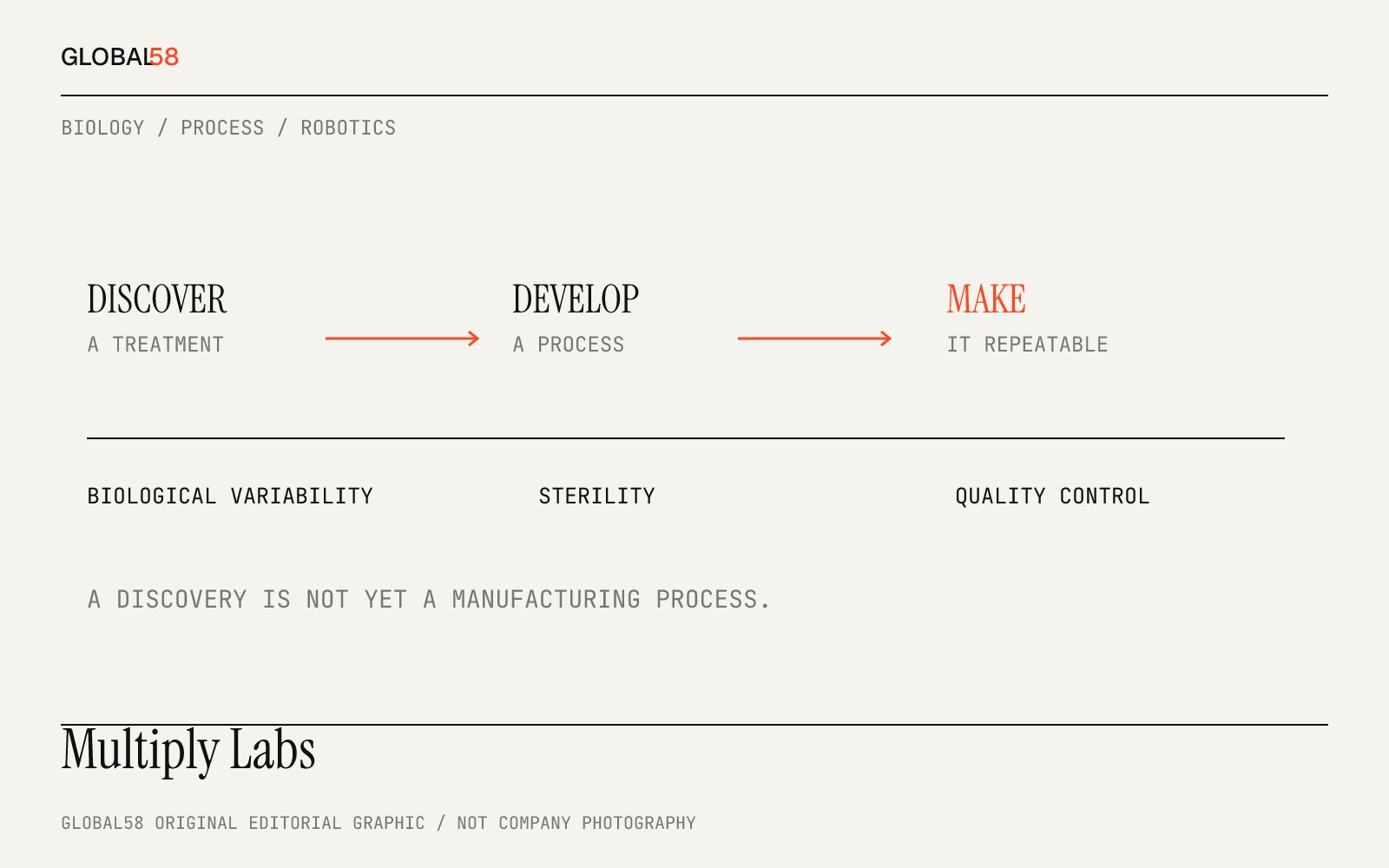
A medicine is not finished when a promising molecule or cell therapy is discovered. Multiply Labs is building robots around the delicate physical work between a scientific idea and repeatable production.
Discovery is not the finish line
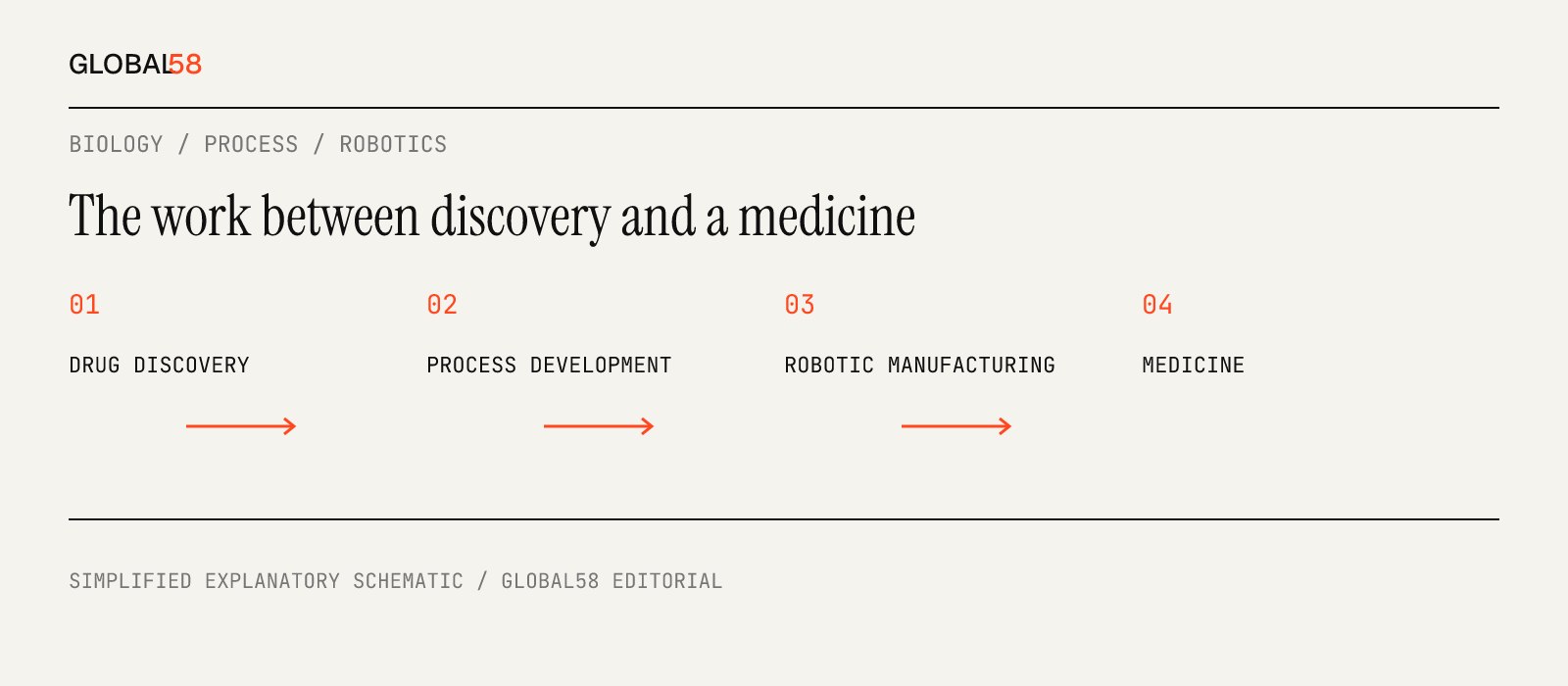
A promising medicine is not yet a manufacturable medicine. Between a scientific breakthrough and treatment reaching a patient lies a physical process: handling materials, growing cells, transferring liquids, operating instruments and showing that the resulting product meets its specifications.
For some advanced therapies, that process remains dependent on skilled people performing delicate, repetitive tasks. Multiply Labs, a San Francisco robotics company founded in 2016, is trying to automate that work. It is not discovering drugs. Its proposition is that robots can operate much of the equipment pharmaceutical manufacturers already use.
The distinction matters as artificial intelligence becomes more prominent in discovery. More computationally generated candidates could increase development and manufacturing demands, but discovery guarantees neither clinical success nor production readiness. Whether a treatment originated with AI or conventional research, someone still has to make it reliably.
On 6 October 2026, Multiply Labs announced a $75 million Series B. That gives the proposition current attention and resources. Capital establishes investor commitment, however, not that robotic manufacturing has become routine across the industry.
Two founders saw the same laboratory differently
Multiply Labs grew out of pharmaceutical science meeting robotics. Alice Melocchi was a visiting doctoral researcher in MIT’s chemical engineering department in 2013 and 2014, working on drug manufacturing. Federico, also known as Fred, Parietti was researching robotics at MIT, including robotic limbs.
MIT’s account describes how seeing Parietti’s machines helped Melocchi imagine another way to perform pharmaceutical work still being done manually. A roboticist could ask how to reproduce a movement; a pharmaceutical scientist also had to ask what that movement did to the medicine and what evidence would make the automated version acceptable.
The early business was not the cell-therapy platform promoted today. Multiply Labs initially pursued personalised supplements and pharmaceutical capsule production before moving into cell-therapy manufacturing. This is an evolving manufacturing company, not a discovery startup retroactively adding robots to its story.
That history helps explain the product philosophy. The aim is less to replace biology with software than to make machines fit biology’s practical requirements. A manufacturing system has to respect the process as well as complete the motion.
Why advanced medicine creates a bottleneck
Cell therapies make the manufacturing problem particularly clear. In an autologous treatment, a patient supplies the starting cells and receives the resulting product. Production may involve isolation, activation, genetic modification, expansion and preparation of the final treatment. Instead of one enormous batch serving many patients, a controlled workflow may have to be repeated for individuals.
Capacity becomes a coordination problem as well as a biological one. Equipment, cleanroom space, operators and processing times must align. A quicker transfer is useful, but it does not remove the time cells need to grow or the requirement to establish product quality.
Multiply Labs’ strongest publicly described technical evidence concerns cell-therapy operations. Its October financing announcement sets out a broader direction including antibodies, viral vectors and mRNA therapies. Those are expansion claims; the sources reviewed do not establish equivalent deployment maturity across all those categories.
Robotics may remove avoidable handling work and help organise parallel production. It does not make every advanced medicine easy to manufacture. Biological variability remains even when the person moving a container is replaced by a machine.
Robots use the equipment already there
Multiply Labs’ central architectural choice is to manipulate existing instruments and consumables rather than require a wholly new production method. Its published research describes a modular cluster with custom robotic end-effectors handling syringes, vials, bags, cell counters, bioreactors, incubators and closed centrifuges. A 2026 industry account describes newer systems using four robotic arms in parallel.
The approach addresses an adoption obstacle. Manufacturers have invested in equipment, procedures and the evidence supporting them. Preserving more of that workflow may make automation easier to introduce than a system requiring wholesale redesign.
Existing equipment does not mean effortless installation. Instruments designed for human hands can be awkward for machines. Flexible bags, small parts and liquid-handling operations present different challenges from moving standardised components along a conventional factory line.
Multiply is effectively building a robotic operator around a laboratory workflow. The ambition is to coordinate instruments into a manufacturing system without unnecessarily changing what happens to the cells. That requires interfaces, scheduling and reliable handling, not simply a capable arm.
Automation is harder than replaying a demonstration
A scientist performing a familiar procedure makes constant adjustments: repositioning a container, assessing a connection, compensating for orientation or noticing an unexpected result. Turning that into repeatable machine behaviour requires more than recording an ideal sequence.
Multiply Labs’ June 2025 Kyverna announcement describes Resonance, its robotic auto-training pipeline, as learning from video demonstrations through segmentation and trajectory extraction. NVIDIA’s January 2026 account describes simulation and digital twins used in development. These are company and technology-partner descriptions, not independent demonstrations that every manufacturing exception has been solved.
Simulation can test layouts and movements before physical hardware changes. Demonstration-based learning can translate a human procedure into robotic actions. Neither eliminates testing with real instruments, materials and biological variability.
In medicine, completing a motion is only the beginning. The consequential question is whether the operation is consistent while preserving required product characteristics. A visually successful demonstration cannot establish that on its own.
What the experiments establish
A paper published online on 4 August 2026 in International Journal of Pharmaceutics: X compared a modular robotic cluster with skilled human operators. Researchers evaluated transfers between sterile bags, cell counting, drawing liquid into a syringe, and resuspension and sampling from bags and a G-Rex bioreactor. The system also performed isolation using a CytoSinct 1000 and washing or buffer exchange using a CTS Rotea system.
The authors reported equivalent performance on selected key metrics for the operations tested. That is more informative than a polished robot video because it connects handling to measured manufacturing outcomes. Its scope is also narrower than a claim that a whole commercial therapy has been manufactured autonomously.
The paper describes specific unit operations as a foundation for future integrated end-to-end production. Its authors include Multiply Labs employees and collaborators. It is peer-reviewed, company-involved research, not independent replication of an entire manufacturing process.
The date needs care: the paper belongs to a December 2026 collection but records online publication on 4 August. The evidence was available before this feature’s October reporting cutoff. The later collection date is not a future technical achievement or a reason to present the experiment as newly performed in October.
Partners are real; their stages differ
A partner list is not a production census. Multiply Labs announced a Kyverna Therapeutics pilot in June 2025 to evaluate automation for KYV-102 processes. A pilot establishes an evaluation programme, not a completed commercial rollout.
In January 2026, it announced an agreement with AstraZeneca to assess the potential use of GMP-ready systems in commercial-scale cell-therapy manufacturing. Pharma Manufacturing independently reported that evaluation scope. Neither description establishes that an AstraZeneca commercial treatment was already being routinely produced on the platform.
The newsroom records collaborations with Legend Biotech, Thermo Fisher Scientific and Stanford’s cell-and-gene-medicine manufacturing facility. These span therapy developers, instrument integration and process-development settings. They are not interchangeable evidence of deployment.
There is earlier operational history in another application: the newsroom records a December 2022 robotic capsule-manufacturing deployment with WuXi STA. That supports a manufacturing history but cannot establish the maturity of present cell-therapy clusters. Reviewed sources do not disclose a reliable total of installed cell-therapy systems, released patient doses or sustained utilisation.
Preserving a process does not remove validation
Multiply’s strategy aims to minimise process changes. It does not make validation disappear. A 2025 trade article suggested that replicating approved manual processes overcomes regulatory hurdles associated with validation. That formulation is too broad to adopt as a conclusion.
Using the same instruments can reduce the scope of a change, but a different operator and control system still require suitable evidence. The scientific work offers the more defensible approach: compare manual and robotic operations on relevant measures and establish what those results support. A successful isolation experiment does not authorise every therapy that might use it.
Equipment qualification, software controls, traceability, aseptic performance, deviations and product-specific requirements remain relevant. “GMP-ready” describes intended suitability for a regulated environment; it is not universal regulatory approval.
The October announcement describes systems that learn and adapt. In regulated manufacturing, that makes controlled configuration and documented change management more important, not less. An automated process must remain understandable and accountable when its behaviour changes.
Promising economics, unanswered denominators
The economic case combines reduced manual handling, better use of costly manufacturing space and parallel operations. Multiply’s October announcement claims a 74% reduction in cost per dose and up to 100 times manual throughput. These are company claims, not established results across customer facilities.
The denominator matters. Earlier partner communications framed the 100-times ambition as patient doses per square foot of cleanroom space. Space productivity is not the same as making each treatment 100 times faster. Nor does lower manufacturing cost imply an equivalent reduction in a medicine’s price.
A useful comparison would include installation, integration, consumables, maintenance, validation, downtime, staffing and actual utilisation. Reviewed sources do not provide enough information for a general payback calculation.
The $75 million Series B was led by Patrick Soon-Shiong with NantWorks. New investors included AstraZeneca, Lingotto, Teradyne and Strange Ventures alongside returning investors. Multiply reported total capital raised above $100 million and plans to expand capacity, product development and staffing. Those resources can help test the economic case; they do not settle it.
Why Global58 noticed them
Multiply Labs addresses an unglamorous dependency of medical progress: discovery matters to patients only when a treatment can be made. Its distinctive choice is pragmatic. Rather than ask manufacturers to abandon their equipment and processes, it builds robots around them.
That provides a plausible route into an evidence-intensive industry and a difficult engineering problem. The next meaningful milestones are integrated complete workflows, sustained performance, customer-specific validation and transparent economics, not simply more partnerships or impressive footage.
The October financing release describes a transition from clinical-stage deployments towards commercial-scale production. That places its ambitions ahead of what should be considered broadly proven. It has experimental evidence for important operations, recognisable partners and fresh capital; their translation into routine production across therapies and facilities remains unresolved.
Global58’s Proximie coverage examines a different gap between medical capability and practical delivery: connecting people and information in operating rooms. Multiply examines the physical process that must precede treatment. AI may expand what researchers can propose. The manufacturing question is how much of that medicine can actually be made.
See something that needs correcting? Contact the Global58 editorial team.