The race to build one brain for every robot.
Skild wants intelligence to travel between robot bodies. Its 2026 video-prompted model makes that ambition more concrete, but a compelling demonstration is still not a dependable factory shift.
The expensive part is teaching the machine
A robot arm can repeat a movement with extraordinary precision. The harder proposition is asking it to cope when the part moves, the packaging changes or the next job requires a different sequence. Mechanical capability does not automatically translate into adaptable work.
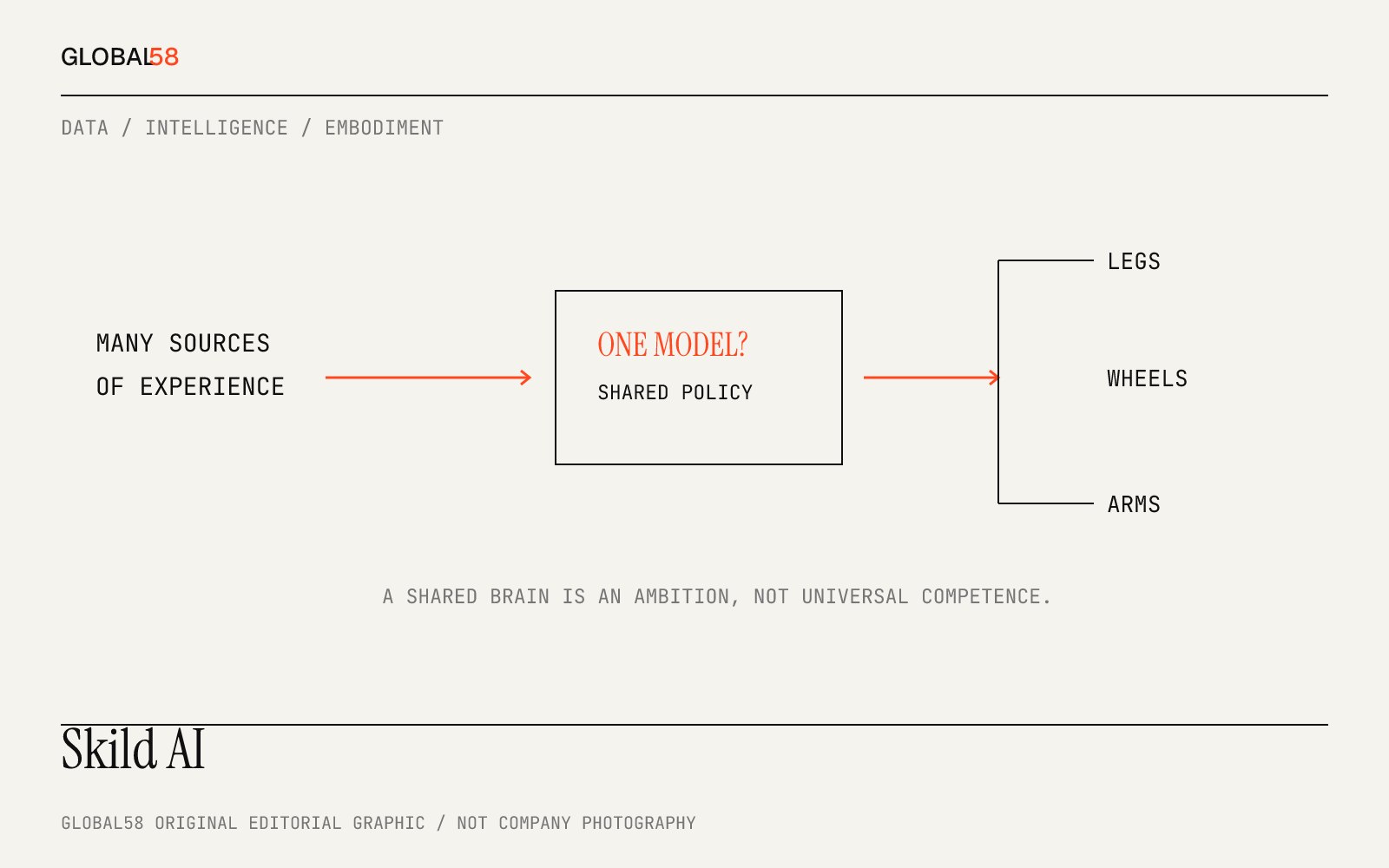
Skild AI is built around that gap. Rather than designing one robot for one market, the Pittsburgh company is developing intelligence intended to travel between machines: industrial arms, four-legged robots, humanoids and mobile manipulators. Its proposition is not that bodies cease to matter. It is that software should learn enough about bodies and physical tasks to reduce the engineering required for each deployment.
The company calls that software the Skild Brain. In its July 2025 technical introduction, Skild described a shared foundation model subsequently fine-tuned and distilled for deployment. That qualification matters: one brain means a common learned foundation, not necessarily an identical, unmodified software package operating every machine. Universal capability remains the ambition, not an established result.
A research idea becomes a company
Deepak Pathak and Abhinav Gupta founded Skild AI in 2023, drawing on their work at Carnegie Mellon University. Pathak is chief executive and Gupta is president. Forbes identified the founders and Pittsburgh base when Skild emerged publicly in July 2024; its public emergence should not be mistaken for its founding year.
Their research background helps explain the approach. Skild’s technical introduction cites earlier work on robots learning to grasp through repeated attempts, curiosity-driven exploration, imitation from human videos and transferring simulated experience into real locomotion. The connecting idea is that useful behaviour can be learned from experience rather than specified movement by movement.
That lineage is relevant, but it is not commercial proof. A research result establishes a capability under particular conditions. A product must reproduce useful performance across customers, equipment and operating schedules. Skild’s challenge is to turn learning methods into something an operations manager can depend on.
What a foundation model has to control
Traditional automation is not simply a collection of rigid scripts. It includes sophisticated perception, planning, control and safety systems. Nevertheless, introducing a new object, task or robot can require substantial integration and validation. The cost is often in making the whole system work, not buying the arm.
Skild wants more adaptation to reside inside a learned model. Its published architecture separates a relatively slow, high-level policy for manipulation and navigation from a fast, low-level policy that translates commands into joint angles and motor torques. This connects decisions about what to do with the physical control needed to do it.
Recognising a dishwasher or describing how to load it is not equivalent to controlling a gripper around a fragile plate. A robotics foundation model must connect perception to actions, contact and changing conditions. Knowledge that can be expressed in words is only part of the problem.
Skild argues that training across tasks and hardware builds reusable physical knowledge. Its criticism of language-first approaches is not a settled verdict on competitors. The practical question is whether the model lowers deployment effort while improving reliability, not whether it wins an argument over the foundation-model label.
Simulation is abundant; reality is expensive
Skild’s January 2026 announcement describes four principal data sources: large-scale simulation and internet video for pretraining, followed by teleoperation and experience from deployments for post-training. It claims very large synthetic and video datasets. Those are company-reported scales, not independently audited measurements.
Each source solves a different problem. Simulation permits repeated practice without wearing out hardware or putting people nearby. Human video supplies examples of objects, activities and intent. Teleoperation connects observations directly to robot actions. Deployment data exposes conditions a laboratory or simulator may overlook.
None is sufficient alone. A video generally does not reveal the forces at a person’s fingertips. A simulator approximates friction, deformation and contact. Teleoperation is closely matched to hardware but costly to collect. A successful training recipe has to bridge those gaps rather than pretend they do not exist.
Skild’s S1 technical account explicitly acknowledges the trade-offs. Teleoperation sits close to the robot but is difficult to scale; egocentric video is scalable but separated from robot hardware by a larger domain gap. The recipe is a mixture, not evidence that synthetic experience has made reality unnecessary.
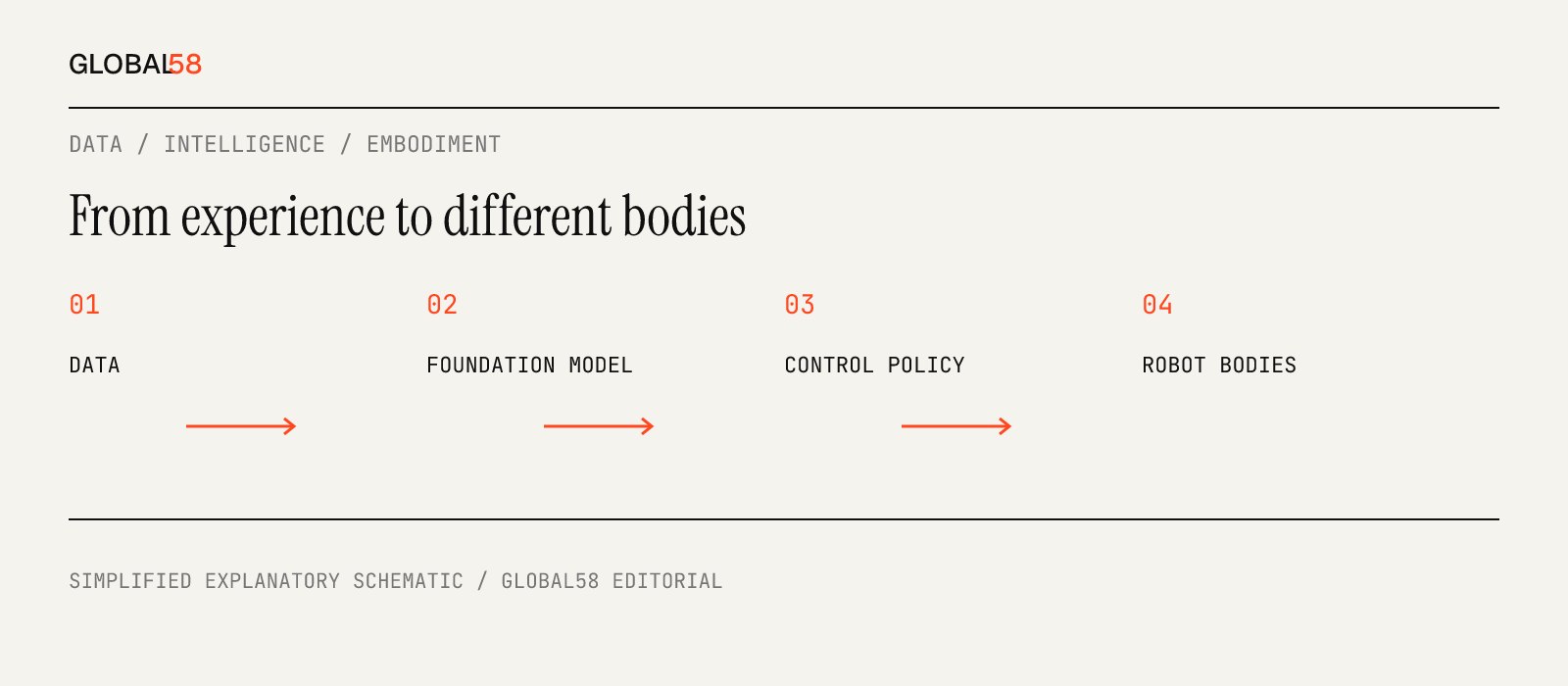
One foundation, several kinds of body
The range of machines is central to Skild’s thesis. Its published work spans quadrupeds, humanoids, tabletop arms and mobile manipulators. An arm reaches and grips; a quadruped maintains balance and negotiates terrain; a mobile manipulator coordinates movement through a space with work on objects.
Training across those forms could create useful transfer. Different machines encounter common problems involving geometry, obstacles, contact and uncertainty. Diversity might make a model less dependent on one narrowly defined configuration. That is the rationale for a shared foundation.
Embodiment nevertheless remains a constraint. A robot cannot reach beyond its workspace, lift beyond its load rating or sense information its hardware never captures. Transferable intelligence still needs suitable interfaces and validation on the target machine. Generality in software does not grant new physical capabilities to the body.
The commercially useful destination may be less dramatic than a robot that does absolutely anything. Reusable grasping, navigation or handover capabilities could make applications easier to build while remaining bounded by particular tasks and environments.
A demonstration becomes the instruction
Skild’s 2026 S1 release uses a video demonstration in the model’s context window to guide execution. The company says the same model weights generated its examples, including plant potting, pancake cooking, pour-over coffee and kit assembly. The demonstration supplies the instruction without updating those weights.
This is in-context learning. Skild presents tasks lasting approximately ten minutes and describes them as absent from pretraining. That is a more interesting claim than replaying a recorded trajectory: the model is meant to infer the demonstrated intent and translate it into actions suited to its current scene and body.
The scorecard requires care. Skild reports 66% performance on unseen tasks against 9% for a language-prompted baseline at the same 100,000-hour training scale. But the stated metric averages cumulative per-step success rates, and the evaluation permits human intervention to recover from failures, mainly for the baseline. Those percentages are not an independently verified rate of completing entire unfamiliar jobs without assistance.
The examples support a promising technical direction. They do not establish production-wide reliability, safe unsupervised operation or transfer to arbitrary hardware. The difference between a recorded success and a dependable service is the repeated work the evaluation cannot yet show.
Capital is not a robotics benchmark
Skild announced a $1.4 billion Series C on 14 January 2026 at a valuation above $14 billion. SoftBank led the round. Named participants included NVentures, entities administered by Macquarie Capital and Bezos Expeditions, alongside returning investors including Lightspeed, Felicis, Coatue and Sequoia. Crunchbase News independently reported the round and valuation.
That capital can fund computing, data collection, research and deployment teams. It cannot establish whether a robot performs economically useful work more reliably than existing alternatives. A financing price is not a measure of generality, revenue quality or profitability.
Accessible accounts differ on cumulative funding, so the confirmed round is more defensible than a single aggregated total. No later completed financing was verified for this feature. The January round remains relevant as resources for the present technical programme, not a new October announcement.
Related bets, different comparisons
Physical Intelligence also pursues models that can control different robots. Its website announced a Pi API beta on 13 October 2026, offering data upload, fine-tuning and cloud-hosted inference on customers’ machines. Both companies seek an intelligence layer beyond one proprietary body. An API announcement alone does not establish comparable economics or reliability.
Figure combines learned intelligence with its own humanoid platform. Its September Helix 2.5 report describes tests of three whole-body behaviours in 30 previously unseen homes. Figure says no adaptation occurred in those test environments, while noting its foundation model had been adapted into the behaviours beforehand.
These are company-reported results under different conditions. Figure’s control of hardware and software differs from Skild’s cross-embodiment strategy, and Physical Intelligence’s developer offering supplies another distribution route. Without a shared evaluation of completion, intervention, speed and cost, ranking the videos would manufacture certainty.
Global58’s Figure feature examines the related question of putting a humanoid onto the factory floor. Skild makes the intelligence layer itself the organising idea. Neither choice exempts the resulting machine from the operational demands of the workplace.
Deployment changes the business
In September, Skild’s founders reported more than $100 million in annual recurring revenue, over 60 paying customers and $50 million in recognised revenue since commercial deployments began ten months earlier. These are company disclosures, not audited financial statements. Annual recurring revenue is not revenue already earned, and neither measure establishes profitability.
The update distinguishes projects at different stages: deploying dual-arm manipulators with NVIDIA and Foxconn for Blackwell-system assembly, working towards S1 deployment at Sumitomo Wiring Systems, and piloting commercial-kitchen robots with Mitsui. Deployments, intended deployments and pilots should not be collapsed into one category.
The business has also moved beyond a clean software-hardware separation. In April, Skild acquired Zebra Technologies’ robotics division, formerly Fetch Robotics. The Robot Report confirmed plans to support the installed base, sell new Fetch robots and integrate Skild Brain. Transaction terms were undisclosed.
Rollout remains qualified. Technical.ly reported in September that Gupta expected the newest S1 technology to be ready for broader real-world installation in 2027 after customer testing. Existing commercial activity is therefore not evidence that every advertised S1 capability is already generally available.
Why Global58 noticed them
Skild is addressing a consequential bottleneck: the expense of teaching physical machines new work. Cross-embodiment learning, video prompting and deployment infrastructure give the question substance. Its public evidence leaves enough unresolved to resist a victory narrative.
A September research update explores physical self-play through simulated competition, including soccer. That establishes another research direction, not autonomous improvement across open-ended industrial work. Suggestions of broader superhuman capability remain hypotheses beyond the demonstrated setting.
The next consequential evidence will be operational: sustained throughput, intervention frequency, recovery from unfamiliar failures, commissioning time, maintenance burden and total cost. Safety must hold when objects slip, sensors degrade or people behave unexpectedly, not only when a demonstration proceeds as intended.
The decisive test is whether a customer can change a useful task, teach the machine quickly and trust the resulting work repeatedly. That is where a general-purpose robot brain would become more than a compelling description.
See something that needs correcting? Contact the Global58 editorial team.