SpaceX isn't the only company trying to make the whole rocket reusable.
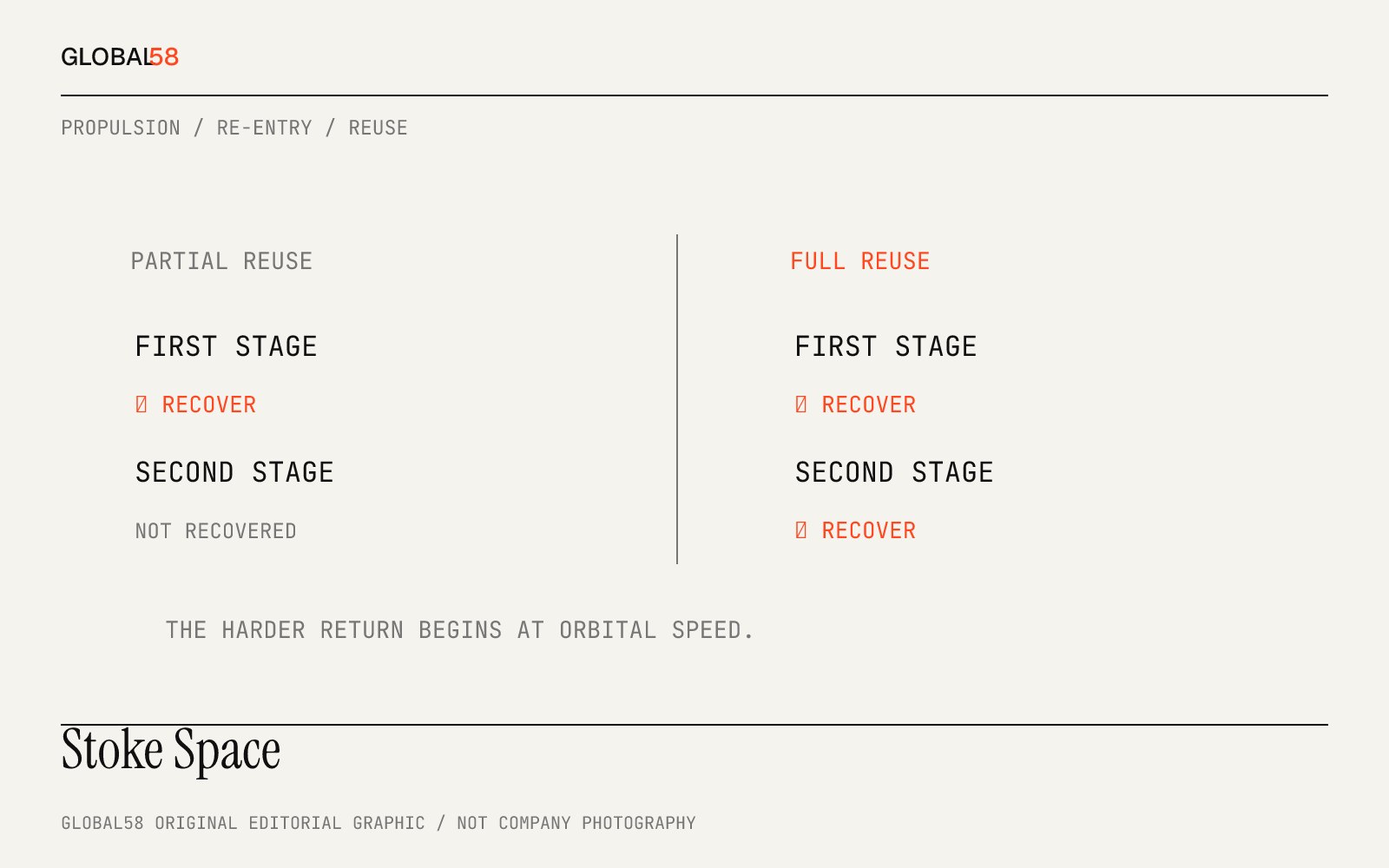
Returning a booster is only part of rocket reuse. Stoke is designing an orbital stage whose engine and heat shield work together, with flight hardware advancing but the complete round trip still ahead.
The stage that usually does not come home
A rocket booster landing upright is no longer an unfamiliar image. But the stage that carries a payload into orbit has done a different job, at a different speed. Getting that machinery back in a condition worth flying again is the problem booster landings do not solve.
Stoke Space is developing Nova, a launch-vehicle family designed to recover both its first stage and orbital upper stage. The Washington company’s defining work is not simply another landing booster. It is an upper stage whose propulsion and actively cooled metallic heat shield are designed together.
There is substantial hardware behind the proposition, but no demonstrated Nova orbital round trip in the evidence reviewed. On 16 October 2026, Ars Technica reported the upper stage moving from the Kent factory to Moses Lake for cryogenic proof testing and an engine hotfire campaign. A move into testing is a development milestone, not survival of orbital reentry.
Stoke’s current schedule targets the first flight of Nova Pathfinder, its initial orbital configuration, for the first part of 2027. Fully reusable Nova remains a development programme rather than an operating launch service. That is the starting point for assessing its engineering, not a detail to leave until the end.
The founders began with the economics
Andy Lapsa and Tom Feldman founded Stoke in 2019. Lapsa, chief executive, describes its starting question as economic: what launch system could support frequent flights without repeatedly manufacturing its expensive machinery?
A company can prioritise a first successful launch and address recovery later. Stoke instead made full and rapid reuse foundational, bringing the upper stage’s return problem into the original design. That choice makes development harder before it provides any demonstrated operating saving.
In a June 2025 essay, Lapsa identifies two costs: manufacturing rockets and maintaining factories, facilities, workforce and infrastructure. Reuse addresses the first; enough flights to spread overhead address the second. A recovered vehicle standing idle does not automatically deliver low-cost access to space.
This is the founders’ thesis, not an independently established forecast of Nova’s costs. It nevertheless explains why an unconventional upper stage became a central engineering problem before Stoke had an orbital flight record.
Nova is a family, not a frozen design
The current programme needs to be understood through Stoke’s September 2026 update, not older descriptions of one rocket nearing launch. Nova Pathfinder is the initial orbital configuration. Its booster uses seven Zenith engines burning liquid oxygen and liquefied natural gas, with a full-flow staged-combustion cycle.
Nova Block 2 is a larger follow-on configuration, targeting 15 metric tons to low Earth orbit in a fully reusable arrangement. The proposed booster uses fourteen Zenith engines; the upper stage changes propulsion and tank geometry. These are design targets, not delivered payload performance.
Pathfinder is intended to establish flight experience and demonstrate reuse technologies. Block 2 scales the system. Shared technology does not make them interchangeable, particularly when the larger upper stage has a redesigned engine arrangement.
For readers following the programme, names and versions matter. A result from a developmental hopper, an earlier engine or Pathfinder cannot automatically establish a Block 2 capability. Iteration is evidence of engineering work, but it also limits what can be inferred from yesterday’s tests.
One recovered stage is not a recovered rocket
A first stage separates before the upper stage has finished accelerating to orbital speed. Its companion continues onward with the payload, accumulating the velocity that makes orbit possible. That additional energy must be managed on return.
The upper stage needs thermal protection, attitude control, suitable propellant management after time in space, restart capability where required and a recoverable landing condition. The necessary equipment consumes mass that could otherwise support payload performance. Reuse introduces trade-offs even before its benefits can be measured.
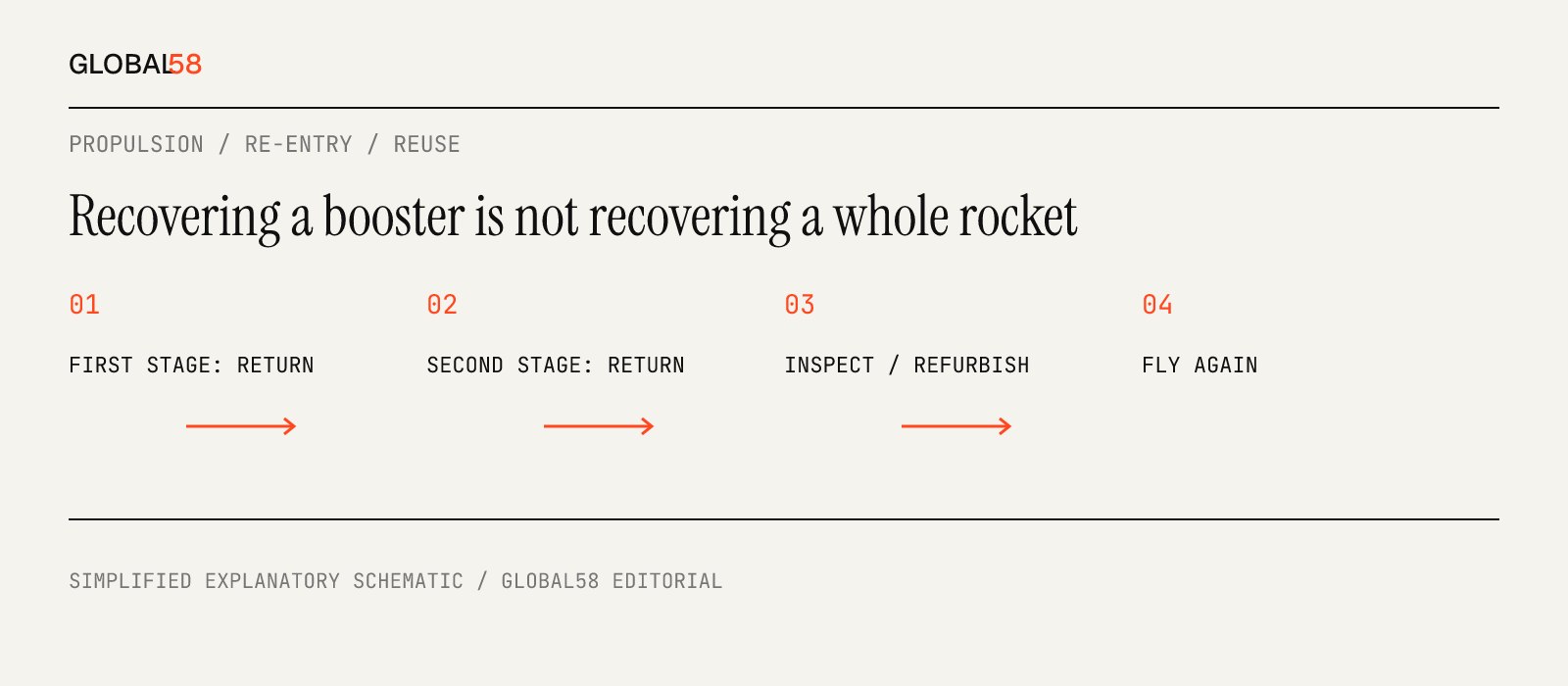
Stoke wants to preserve the upper-stage tanks, engine and associated systems instead of replacing them after each mission. “Fully reusable” describes the intended architecture, not immediate reuse without maintenance or a promise that every consumable and mission-specific component returns.
The commercially meaningful questions are how much valuable hardware survives, what work it needs and how soon it can fly again. A landing is an event. Reusability is a repeated operating capability.
The engine and heat shield share a working fluid
Nova’s defining feature is a metallic base heat shield cooled by liquid hydrogen, also carried as upper-stage fuel. Hydrogen flowing through the shield absorbs heat; thrust chambers are distributed around and integrated into the base. This is active thermal protection, not an uncooled plate expected to withstand reentry on its own.
The arrangement should not be described as 24 separate engines across every version. Stoke’s September explanation says Pathfinder uses common turbomachinery feeding distributed thrust chambers. Block 2 retains 24 chambers but reorganises them into twelve independent engines, each with two chambers and its own turbomachinery.
Block 2 also includes a separate reentry pump to circulate hydrogen through cooled surfaces. The propulsion and cooling systems share a working fluid but become less tightly coupled operationally. Stoke describes a closed hydrogen expander cycle and intended engine-out resilience. These are design descriptions, not recovered-flight results.
Earlier prototypes had different chamber counts. Their tests cannot establish the performance of the latest configuration without qualification. Stoke argues active cooling could reduce inspection and refurbishment compared with tiles; orbital recovery and turnaround evidence are still needed to test that claim.
Orbital reentry is the decisive environment
A short vertical flight can demonstrate control, throttling and landing. It cannot recreate returning from orbit. Atmospheric entry requires the vehicle to shed kinetic energy while protecting its structure and systems from severe heating and aerodynamic loads.
For an actively cooled shield, suitable coolant flow and pressure must be maintained as heating changes. Orientation has to keep protected surfaces facing the incoming flow. Pumps, plumbing, seals, joints and control systems must cooperate through ascent, spaceflight, entry and landing.
A successful component test is necessary evidence, not a complete mission. Pathfinder’s upper stage has tapered sidewalls intended to shelter behind the base shield. Block 2 uses cylindrical tanks for more volume and a five-metre fairing; Stoke says entry geometry will shade its sidewalls from peak heating.
Pathfinder data will therefore inform the larger vehicle. Actual thermal margins, repeated-entry durability, coolant requirements and postflight maintenance remain open in the absence of recovered Nova orbital flights. The promise of simpler refurbishment belongs on the list of things to demonstrate.
What has flown, and what has not
Hopper2 remains Stoke’s clear early flight demonstration. On 17 September 2023, the developmental vehicle flew approximately 30 feet high during a 15-second test at Moses Lake and landed about 15 feet from its starting position. GeekWire reported the flight and its role in upper-stage development.
Subsequent technical reporting described deep throttling and differential-thrust control, varying thrust around the vehicle to steer rather than relying on a conventionally gimballed main engine. NASASpaceFlight reported a February 2024 test of a then-current 30-thruster configuration.
The October 2026 Ars account describes completed first-stage structural proto-qualification and shipment of the upper stage for further tests. Together these milestones establish a substantial development effort. They do not establish an integrated Nova reaching orbit, surviving orbital reentry, recovering both stages or reflighting either orbital stage.
That boundary is practical, not semantic. Stoke has tested pieces of the recovery problem. The combined orbital mission is what will reveal whether the pieces work together under the conditions that matter.
Financing a launch and recovery system
On 8 September 2026, Stoke announced an initial closing of a billion-dollar Series E, bringing its stated capital raised to $2.3 billion. Point72 Ventures and Spark Capital co-led. “Initial closing” matters: GeekWire reported Lapsa saying the final amount would be approximately a billion dollars. This is announced financing, not an independently audited cash balance.
Stoke also describes expansion of its Moses Lake test footprint from 75 to 550 acres. Its Cape Canaveral plans include a payload-processing facility, long-lead equipment procurement and an offshore recovery platform being designed and built. Those investments concern prospective capacity, not an operating high-cadence system.
The published sequence is Pathfinder’s first flight in early 2027, additional Pathfinder missions during 2027–2028 and Block 2’s first flight targeted for 2029. All are company schedules. The reviewed sources do not establish that the first Pathfinder flight will recover both stages or that every regulatory and operational prerequisite is complete.
Infrastructure can be less visually striking than a rocket engine, but launch cadence depends on it. Payload handling, range availability, recovery logistics, transport and inspection all affect how often reusable hardware can actually earn revenue.
A fair comparison with SpaceX
Reuse is valuable only if the hardware earns its keep. A returned upper stage needing lengthy disassembly might save manufacturing expense without enabling frequent flights. A durable vehicle cannot spread fixed costs if payload demand, launch infrastructure or recovery logistics keep it grounded.
Nova has no public operational cost record against which to verify savings. Customer prices, marginal flight costs and fully allocated business costs are not interchangeable. Stoke needs reliable recovery, manageable refurbishment and sufficient utilisation to work together.
SpaceX supplies two comparisons. Falcon 9 demonstrates the commercial value of booster reuse while using an expendable orbital second stage. Starship pursues both-stage recovery at a different scale and with a different thermal-protection architecture. SpaceX is much further into integrated flight testing.
October 2026 reporting documents Ship 40 returning to Texas after sea recovery following Flight 13. Recovery is meaningful but is not by itself reflight or routine rapid upper-stage reuse. The fair comparison is not that Stoke has matched SpaceX; it is that another company is pursuing the broad objective with a distinct design and substantially less flight evidence.
Why Global58 noticed them
Stoke tackles what booster landings leave unresolved: bringing valuable orbital machinery home in a condition that makes another flight worthwhile. Physical tests, flight articles and an identifiable engineering approach make the proposition substantial. Its central uncertainty is equally identifiable: the integrated recovery-and-reflight cycle remains unproven.
Success should be measured progressively. First comes orbital delivery, then controlled entry, thermal survival and recovery. Inspection results, replacement requirements and a second flight of recovered hardware follow. Repeated missions must show whether turnaround and total costs support the economics.
Global58’s Agnikul coverage examines a different launch-manufacturing bet, while Varda makes capsule return part of pharmaceutical processing. Stoke’s return problem concerns the launch vehicle itself. These are related efforts to make space infrastructure useful, not interchangeable technologies.
Stoke need not become “the next SpaceX” to matter. Demonstrating an independently developed, repeatable way to recover both stages would broaden reusable launch’s technical and commercial foundations. As of the October reporting cutoff, that possibility is worth following and still unproven.
See something that needs correcting? Contact the Global58 editorial team.