There are factories being built in orbit. Varda wants them to make medicine.
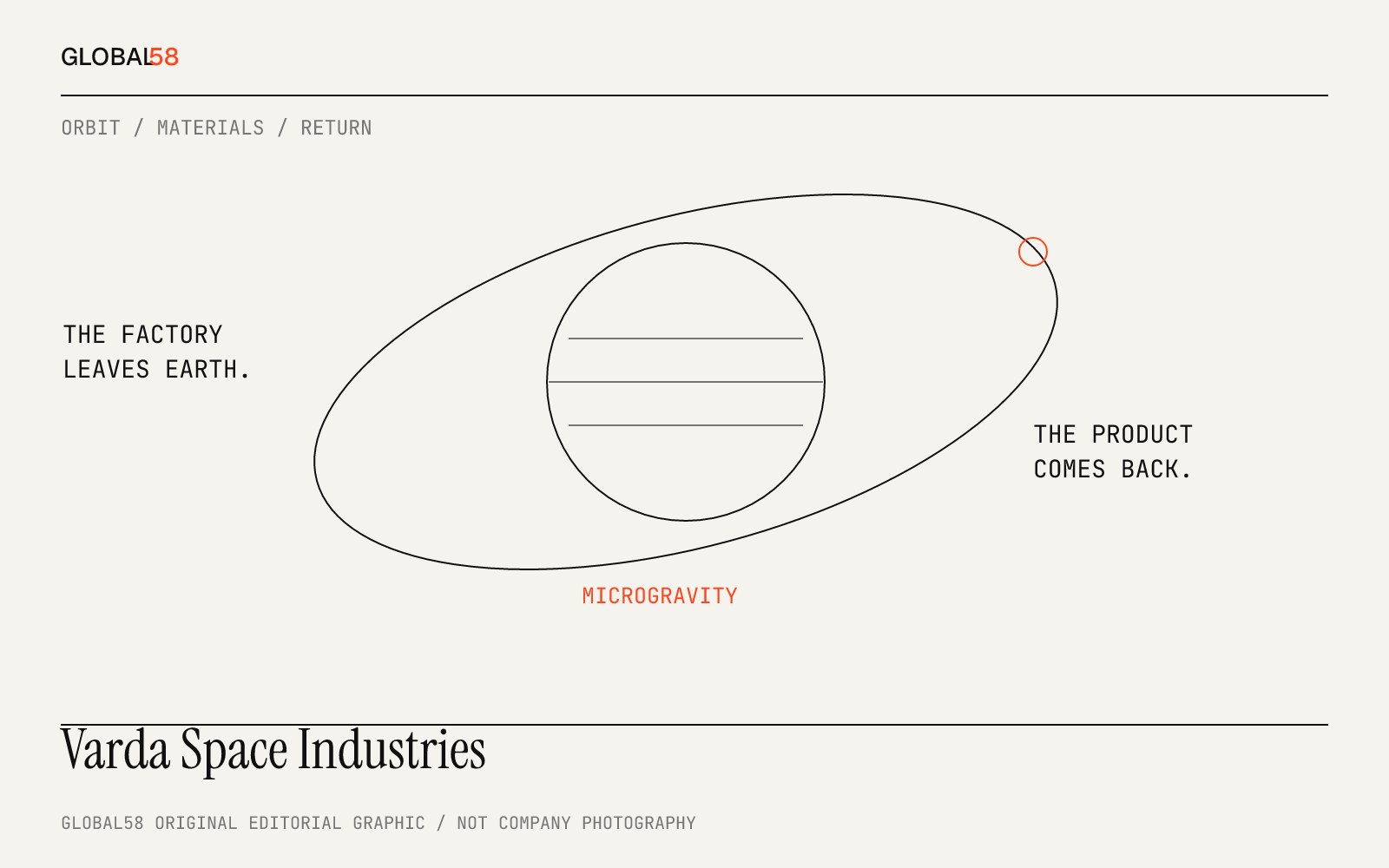
Microgravity can change how a material forms. Varda has returned pharmaceutical samples from orbit; the harder question is whether that round trip can produce a medicine worth making there.
The factory is small. The proposition is not.
A pharmaceutical factory normally has a fixed address. Varda Space Industries is testing one that leaves Earth, works while falling around the planet and returns its material through the atmosphere. The attraction is not the view from the window. It is what happens to a material when gravity no longer drives the same settling and circulation it does on the factory floor.
The most revealing detail of Varda’s first orbital pharmaceutical experiment is its scale. The hardware contained three small processing vials, each holding roughly 150 milligrams of ritonavir, an antiviral medicine. This was not a production line supplying hospitals. It was a controlled test of whether a drug could be processed in orbit and recovered without losing the solid form researchers wanted.
That distinction matters. Varda has demonstrated autonomous pharmaceutical processing followed by recovery and laboratory analysis. It has not thereby demonstrated a commercially viable medicine manufactured in space. A real experimental result and a successful industrial business are different achievements.
By October 2026 the company had moved beyond a solitary capsule. W-8 and W-9 launched together on 1 October, according to Varda and subsequent Space.com reporting. The question is becoming less whether a miniature factory can survive the journey, and more whether pharmaceutical companies can find something valuable enough inside it to justify repeating that journey.
A space company with an earthly customer
Will Bruey and Delian Asparouhov founded Varda in 2021. Based in El Segundo, California, the company is led by Bruey as chief executive and Asparouhov as president. Bruey previously worked at SpaceX; Asparouhov is also associated with Founders Fund. Their proposition is not primarily about supplying people living in space. It is about processing useful materials for people on Earth.
That customer changes the architecture. Varda does not need a staffed orbital settlement or a permanent factory attached to a space station. It needs a compact laboratory, spacecraft systems that keep it operating and a reliable way to bring the material back.
Experiments aboard the International Space Station and earlier spacecraft established much of the scientific background. Varda’s attempted contribution is to package access to that environment into an independent, repeatable service. Avoiding a crewed station removes some constraints, but it does not remove pharmaceutical-development requirements or the cost of spaceflight.
The business therefore sits between industries with different working habits. Space hardware has to survive a flight; pharmaceutical evidence has to survive scrutiny about identity, purity, stability and reproducibility. A useful service has to meet both sets of demands.
Microgravity changes the mixing
An orbiting spacecraft is not beyond gravity. It is continually falling around Earth. That shared free fall produces the near-weightless conditions called microgravity. Inside a sample, familiar effects are reduced: particles settle less readily, and buoyancy-driven convection, the circulation caused when warmer or less-dense fluid rises, is suppressed.
Diffusion can consequently play a larger role in moving molecules through the material. Changes in transport can affect how crystals begin and grow, influencing size, morphology or the solid form that emerges. The environment is different even when the chemical identity of the starting compound is not.
Microgravity is a processing variable, not a universal improvement switch. Results depend on the compound, solvent, temperature history, equipment and other conditions. A material that behaves differently is not necessarily a material that behaves better for the intended use.
Different kinds of crystallisation also need to be kept separate. Growing a protein crystal to study its structure is not the same as producing a useful crystalline form of a small-molecule drug. Decades of space research establish plausibility, not a guarantee that every pharmaceutical process benefits from leaving Earth.
Why a crystal can change a medicine
A drug’s chemical identity does not tell the whole story of its behaviour. The same molecule can pack into different crystal arrangements, known as polymorphs. Those arrangements can have different solubilities, melting points and manufacturing characteristics.
For a medicine that must dissolve before it can be absorbed, those differences can matter. A useful solid form might help with a formulation problem. An unexpected conversion to another form might create one. Crystal engineering is therefore not merely an exercise in making a more elegant microscopic structure.
Ritonavir is an instructive test material because its polymorphism is well documented. Varda’s study focused on Form III, a known metastable form with higher solubility than Forms I and II. Metastable means it can persist without being the most thermodynamically stable arrangement. The question was whether it could survive processing, space exposure and return.
A successful answer would be useful but bounded. Higher material solubility does not automatically establish improved absorption in patients, a safer dose or a superior finished medicine. Those conclusions require further pharmaceutical development and evidence. Varda’s experiment did not test clinical benefit.
What actually happened inside W-1
The W-1 experiment was more specific than “making drugs in space” suggests. Researchers began with ritonavir already manufactured on Earth. The equipment applied a programmed heating-and-cooling process to produce Form III from Form II. This was solid-form processing, not synthesis of a new drug molecule in orbit.
The hardware used stainless-steel vials, heaters, thermoelectric devices and temperature sensors. Control samples travelled alongside the active experiment, allowing researchers to distinguish processing effects from changes associated with the journey itself. Material held and processed on Earth supplied reference comparisons.
W-1 returned to Utah on 21 February 2024. A peer-reviewed paper appeared in npj Microgravity on 8 April 2026. It reports successful recovery of orbitally generated Form III and strong physical and chemical stability in the samples examined. The authors include researchers affiliated with Varda and Improved Pharma, so this is primary experimental evidence, not an independent replication.
Form III was not a new, space-exclusive discovery. The process drew on ground-based development. The demonstration established survivability and operation of the processing-and-return chain, not that orbit was necessary to obtain that material. Its value is in removing an important uncertainty, not in claiming the pharmaceutical question is settled.
The return journey belongs to the factory
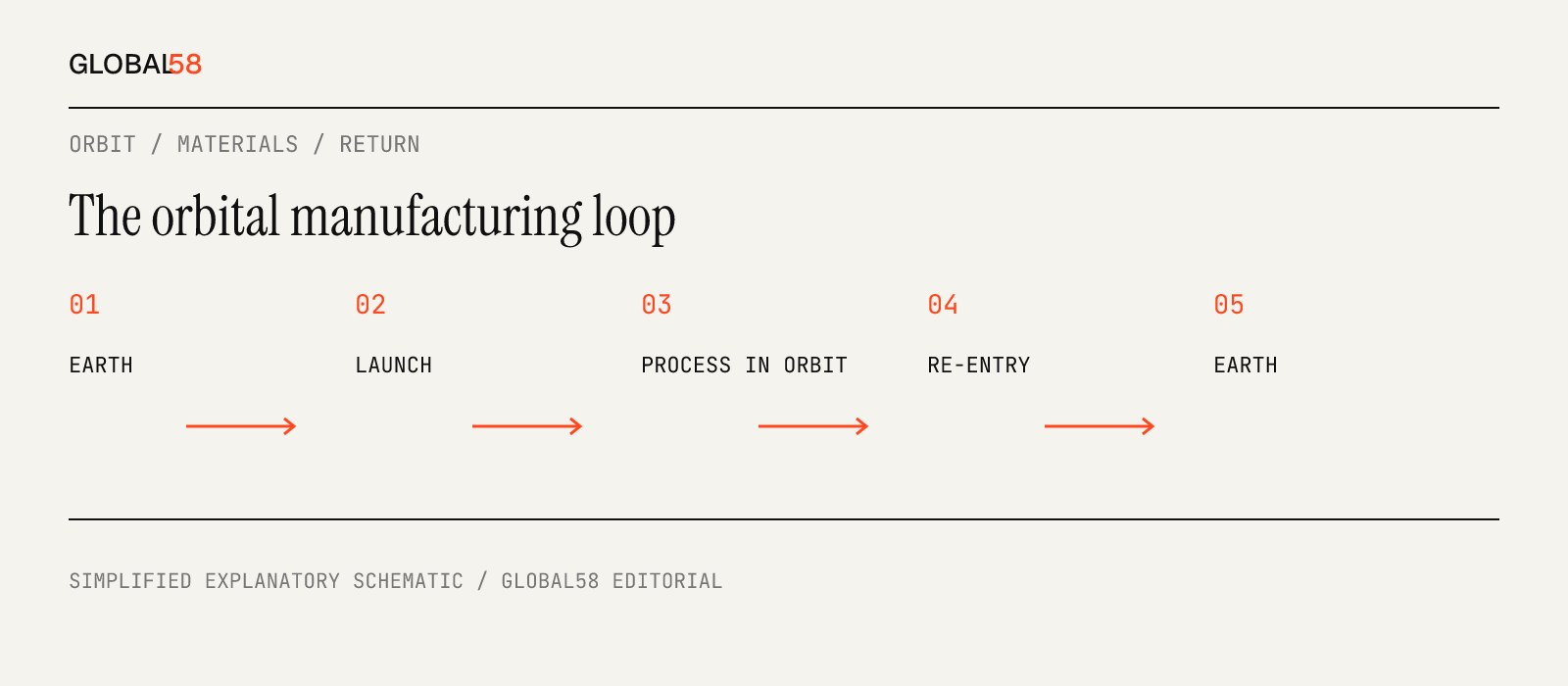
Varda’s service is not simply time in microgravity. It is a round trip. A mission must carry equipment into orbit, provide power and communications, execute the experiment and place a capsule on a controlled return trajectory. The capsule must protect its contents through atmospheric heating and deceleration before descent and recovery.
Early missions relied on Rocket Lab spacecraft infrastructure, as contemporaneous reporting describes. Varda now advertises an in-house orbital-processing and reentry platform. That evolution should not be read as evidence that every historical mission used the same architecture.
Once recovered, material needs pharmaceutical analysis. Researchers have to establish what returned, whether it changed and whether the result can be reproduced. The capsule, recovery operation and analytical laboratory are therefore parts of one manufacturing system.
A promising crystal that cannot be returned predictably, or whose quality cannot be documented, is not a dependable pharmaceutical input. Flight cadence, temperature control, recovery logistics and sample handling become commercial questions as well as engineering ones.
A pharmaceutical collaborator and a second business
In May 2026, Varda announced a collaboration with United Therapeutics to investigate improved formulations of small-molecule treatments for rare pulmonary disease across multiple orbital missions. A named research collaborator is a more concrete signal than anonymous expressions of interest.
The announcement describes research, however. It does not establish an approved space-processed therapy, patient outcomes or a disclosed manufacturing order. The reviewed release did not provide financial terms. A collaboration can be genuine while its therapeutic and commercial results remain open.
Varda also serves customers interested in the return journey itself. Capsules pass through hypersonic conditions, creating opportunities to test thermal-protection materials, sensors and other systems. Its October launch announcement identifies Canopy Aerospace & Defense’s heat-shield monitoring payload aboard W-8 and externally mounted materials supported by government partners, including the Air Force Research Laboratory.
The two activities share expensive infrastructure but answer different questions. A useful hypersonic test can establish value in the vehicle without proving pharmaceutical economics. Describing Varda only as a medicine factory would miss a significant part of the work its current missions perform.
High value, low mass, unfinished arithmetic
On 30 September 2026, Varda announced a $251 million Series D led by Lux Capital and Natural Capital. It reported cumulative capital raised of $598 million. SpaceNews and Space.com reported the round amount; the cumulative figure remains Varda’s account rather than an independently audited reconstruction.
The economic argument rests on high value and low mass. Some pharmaceutical discoveries may require only small quantities of an unusual solid form. In suitable cases, space-derived crystals could potentially seed subsequent processing on Earth rather than requiring every patient dose to make an orbital journey.
That possibility is compound-specific. Researchers have to show that the desired form can be reproduced and maintained under practical conditions. A method that works only once, or cannot be transferred into useful production, is less valuable than the original result might suggest.
A full cost calculation includes spacecraft, launch, process development, recovery, failed experiments and pharmaceutical quality work. More frequent flights and falling mission costs might improve it, but projections are not disclosed margins. The public evidence reviewed does not establish a profitable orbital pharmaceutical product. Financing gives Varda resources to test that proposition; it does not answer it.
Permission to return is not permission to prescribe
A capsule cannot come down wherever a convenient desert appears. The FAA’s original February 2024 licence authorised a single Winnebago reentry subject to specified conditions. That document establishes a particular permission, not blanket authorisation for all later missions.
Varda has since used Southern Launch’s Koonibba Test Range in South Australia. The Australian Space Agency recorded W-2’s successful February 2025 return and the statutory authorisation behind it. Different landing opportunities involve different authorities, trajectories and recovery arrangements.
A repeatable business needs approved trajectories, coordinated airspace, landing access and recovery plans alongside launch bookings. Each link in the round trip must be available when the experiment requires it.
Separately, any resulting medicine must satisfy applicable pharmaceutical requirements. A spaceflight authorisation says nothing about clinical benefit. An attractive solid form still has to become a reproducible drug substance or product with appropriate controls and evidence. The two regulatory journeys intersect operationally; neither can substitute for the other.
Why Global58 noticed them
Varda connects an unusual scientific environment to an ordinary industrial requirement: a customer needs a material with useful, reproducible properties. Its strongest evidence is not an image of factories circling Earth. It is recovered samples, published analytical work, repeat spacecraft activity and a named pharmaceutical collaborator.
The latest independent mission account reviewed for this feature was published on 13 October 2026. It reported W-8 and W-9 in orbit and another mission expected later that month. Varda’s W-7 page described an October experiment involving a protein-degrading compound, or PROTAC, aimed at investigating solubility. A published schedule is not verification of launch or an experimental result.
No later launch, landing or pharmaceutical outcome through the 18 October reporting cutoff was verified here. That boundary matters when spacecraft activity can change quickly and a future milestone sounds almost indistinguishable from a completed one.
The next decisive evidence is a pharmaceutical advantage worth paying for and a dependable route to delivering it on Earth. Varda has built meaningful parts of that route. Whether they lead to a medicine remains open. That combination of concrete progress and an unanswered industrial question is why the company deserves close examination.
See something that needs correcting? Contact the Global58 editorial team.